Commercial Trucking hiring kit

How to hire CDL drivers.

To hire for commercial trucking well, My Trade Talent's Commercial Trucking hiring kit takes all 2 roles we recruit in order: what each seat is and what it pays, the technical questions that test it, the 4 credentials to verify, and what can kill the offer between acceptance and the first day.

2 roles: CDL-A Truck Driver, CDL-B Truck Driver. Free, with nothing to fill in. If you would rather a recruiter ran the search, that is the Commercial Trucking recruiting page.

Step 1 · Plan

What each commercial trucking seat is, and what it pays.

Each band is labelled with where it comes from. A My Trade Talent band is mid-experience, built from our own engagement history, and moves with experience and region. A BLS band is the federal 10th to 90th percentile, national and unadjusted, used where we have not closed enough searches in the trade to publish our own.

Commercial Trucking roles, pay bands and credentials

BLS 10th to 90th percentileEvery bar is drawn on one scale, $25,000 to $85,000.

  • CDL-A Truck Driver

    BLS 10th to 90th percentile

    Operates combination vehicles - tractor-trailer, flatbed, tanker, lowboy - on regional or over-the-road runs: pre-trip and post-trip inspections, load securement, hours of service compliance on an electronic log, and customer delivery conduct.

    Pay band $40,140 to $79,380 Federal figures: BLS Occupational Employment and Wage Statistics, May 2025, national, SOC 53-3032. The range is the 10th to 90th percentile and the median is $58,640. It is not adjusted for experience or region, and it is not a My Trade Talent band.
    Credentials that move an offer CDL-A
  • CDL-B Truck Driver

    BLS 10th to 90th percentile

    Operates straight trucks and single-unit vehicles: service and delivery trucks, dump trucks, boom and crane trucks, vacuum and water trucks.

    Pay band $30,800 to $80,310 Federal figures: BLS Occupational Employment and Wage Statistics, May 2025, national, SOC 53-3033. The range is the 10th to 90th percentile and the median is $44,860. It is not adjusted for experience or region, and it is not a My Trade Talent band.
    Credentials that move an offer CDL-B

We have closed 2 commercial trucking searches in 2026 year to date, too few to publish a median for the trade, so this is the all-trades figure: My Trade Talent's median commercial trades hire took 21 days across 88 searches closed in 2026 year to date, counted as calendar days from our first contact with the candidate to the hire. The full distribution is in the Hiring Index.

Price the seat by experience and region in the salary calculator, and work out what leaving it open costs in the cost of vacancy calculator.

Step 3 · Interview

How to interview for each commercial trucking role.

Everyone who applies will claim the experience. These are the questions that test it, the signals that separate a strong candidate from a plausible one, and the mistake each seat invites.

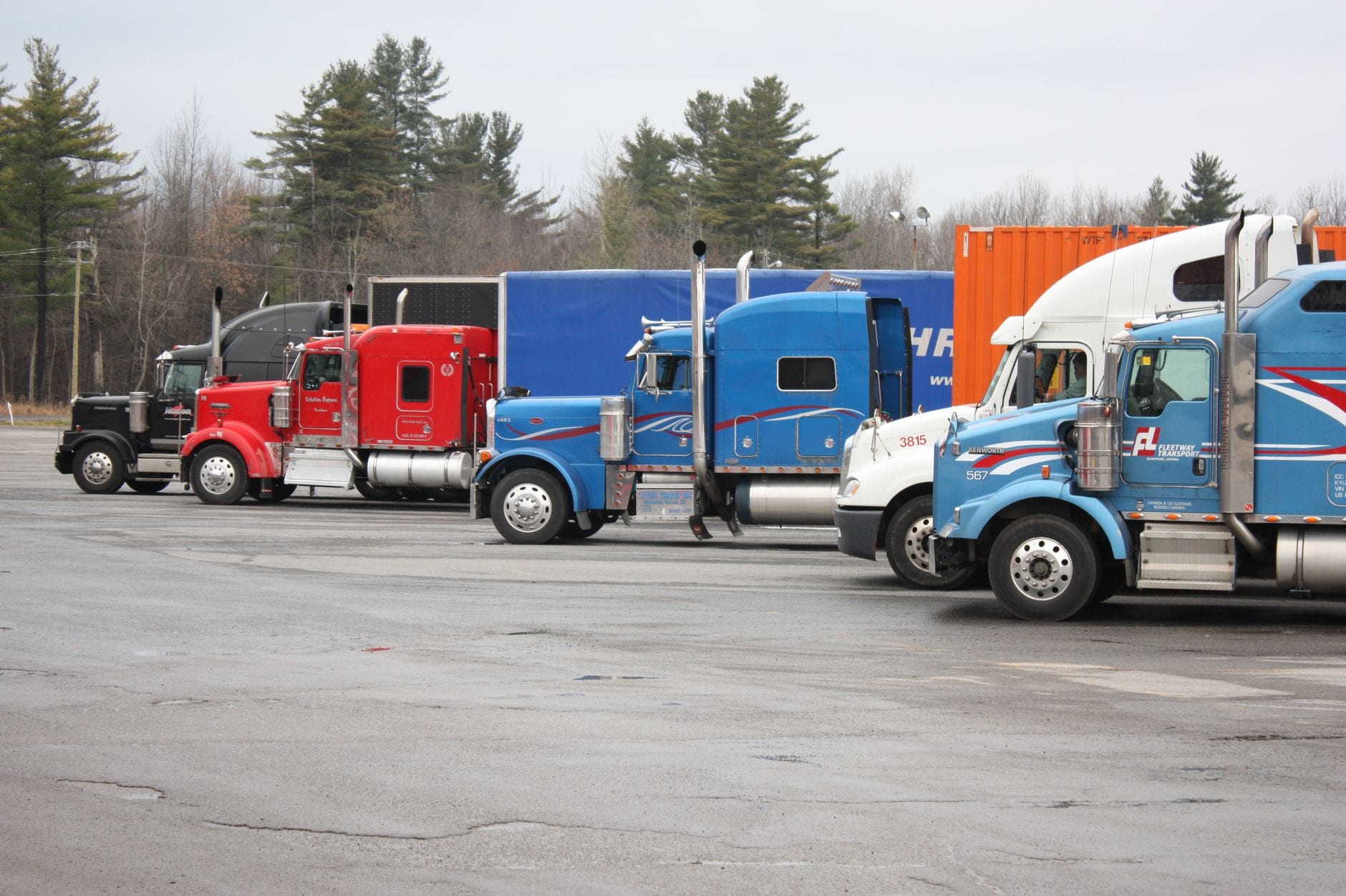
CDL-A Truck Driver

BLS 10th to 90th percentile CDL-A

Operates combination vehicles - tractor-trailer, flatbed, tanker, lowboy - on regional or over-the-road runs: pre-trip and post-trip inspections, load securement, hours of service compliance on an electronic log, and customer delivery conduct. On construction and trades work the load is often equipment or material to a job site.

Questions that find out

  1. Walk me through securing a piece of equipment on a flatbed.

    A strong answer Starts from the working load limits and the rule that the aggregate limit must be at least half the cargo weight, with the minimum number of tiedowns for the length and weight, plus the specific requirement for heavy machinery to be secured at four points through its own attachment points or over the body. Chocks or blocks against movement, secures accessories and articulated parts separately, protects edges, and re-checks within the first few miles and at every stop.

    Follow up with How many tiedowns on a machine, and where does that number come from?

  2. You are approaching your hours limit and the receiver is running late. What do you do?

    A strong answer Treats the limit as a limit. Tells dispatch and the receiver early rather than at the last hour, finds parking before running out rather than after, and does not run over to finish the load. Knows the limited exceptions that genuinely exist and does not stretch them into cover. Says a driver who runs over because the dock was slow is the one who loses the licence, not the shipper.

    Follow up with What exception could legitimately apply here, and what does not?

  3. How do you handle fuelling, scaling and weight compliance on a loaded run?

    A strong answer Scales after loading rather than trusting the shipper's weight, checks gross, axle and bridge limits, and knows how to shift the tandems or the fifth wheel to move weight between axles. Allows for fuel weight burning off over the run. Knows the permit requirements for anything over limits on their route. Says being overweight at a scale is the driver's citation, whoever loaded it.

    Follow up with You are over on the drives and legal on the gross. What do you do?

  4. Walk me through your pre-trip, and what would take the truck out of service.

    A strong answer Works a consistent route - engine compartment, cab and gauges, lights, air system with the brake tests, tyres, wheels and fasteners, suspension and frame, coupling and fifth wheel, trailer and cargo securement, and the paperwork - rather than a glance. Names out-of-service items specifically: brake defects, a steer tyre below limit, air leaks beyond the allowable rate, lighting on the required lamps, a cracked frame, or a defective coupling.

    Follow up with Name three things you find that put a truck out of service.

  5. How do you secure an uneven load, and what are you working from?

    A strong answer Works from the cargo securement rules and the working load limits, not from what looks tight: calculates what the load needs, blocks and braces to stop forward and lateral movement rather than relying on friction, uses dunnage to create bearing where the shape does not give it, and protects the straps at every edge. Rechecks early and often, because an uneven load settles. Will refuse a load that cannot be secured properly.

    Follow up with What do you do with a load whose shape will not take a strap?

  6. What is your approach to trip planning for parking at the end of your hours?

    A strong answer Plans the stop before starting the day rather than looking for parking with half an hour left, with a primary and a backup, and knows the corridors and times where parking disappears. Builds the delivery appointment and the likely dock delay into the plan. Says that most hours violations and most tired-driver incidents come from a plan that assumed everything would go right.

    Follow up with Where were you planning to park tonight before you set off this morning?

  7. How do you handle a delivery site that is not safe to back into?

    A strong answer Stops and assesses rather than attempting it: gets out and looks, checks for pedestrians, overhead obstructions, soft ground and blind sides, and gets a spotter where one is available - knowing a spotter is a help, not a transfer of responsibility. Asks the site for an alternative, or refuses and calls dispatch. Says they have declined to back into something and that the delay was cheaper than the damage.

    Follow up with When did you last refuse to back into a site?

  8. What is your process after any contact, however minor?

    A strong answer Stops, makes the scene safe, checks for injuries, and reports it immediately - to dispatch and to the police where required - rather than deciding themselves that it was too minor to matter. Photographs everything including the position before anything moves, exchanges details, and does not admit fault at the scene. Knows the testing requirements that may follow. Says an unreported minor contact found later is a termination.

    Follow up with Why report something that left no mark?

  9. How do you plan a route with bridge and weight restrictions?

    A strong answer Plans with a truck-specific route and verifies rather than following a car satnav, checking height, weight, bridge limits, hazardous routing and local restrictions, and knows their own height and weight rather than assuming the standard. Checks for construction and seasonal limits. Says they would rather add miles than find out at a low bridge, and that a satnav that is not set for a truck is how bridges get hit.

    Follow up with What is the actual height of the truck you drove last?

  10. What is your approach to a load that shifts in transit?

    A strong answer Stops as soon as it is safe rather than carrying on to the next stop, finds somewhere out of traffic, and inspects before opening anything that might release the load onto them. Re-secures properly rather than adding a strap, and works out why it shifted. Reports it. Knows a shifted load is a rollover risk on the next ramp, and that the driver who kept going is the one who is asked why afterwards.

    Follow up with What is the danger in opening the curtain or the door on a shifted load?

  11. How do you handle a roadside inspection?

    A strong answer Is calm and cooperative, has the documents in order and to hand, and knows what the levels of inspection cover. Does not argue at the roadside; takes the report and raises any disagreement through the proper channel afterwards. Knows their own equipment well enough to answer questions about it. Says their inspection record follows them and their carrier, and that a clean one is worth being pedantic about the pre-trip.

    Follow up with What is on your last inspection report?

  12. What is your process for logging and hours of service compliance?

    A strong answer Logs accurately in the electronic device including on-duty not driving time, which is where most people get sloppy, and knows the driving and on-duty limits, the break requirement and the restart. Does not log loading time as off duty. Knows what to do when the device malfunctions and how long paper logs are permitted. Says the log is the first thing an inspector and a lawyer look at.

    Follow up with What is the most common way drivers log something wrongly?

  13. How do you handle a load that is tendered differently from what is on the paperwork?

    A strong answer Does not sign for what they have not got. Checks the count, the condition and the description against the bill of lading before leaving, notes any discrepancy or damage on the document and gets it acknowledged, and photographs it. Calls dispatch rather than deciding alone. Knows a clean signature on a bill makes the shortage or the damage theirs, and that this is the commonest way a driver inherits somebody else's problem.

    Follow up with What do you write on the bill when the count is short?

  14. What is your approach to winter driving and when do you shut down?

    A strong answer Slows and increases following distance long before it is obvious, knows how the truck behaves loaded and empty on ice, and watches bridges and shaded sections. Has a shutdown threshold - visibility, road closures, or conditions where they cannot maintain control - and uses it rather than pushing on because of a delivery time. Says dispatch has never successfully argued them out of parking it.

    Follow up with What makes you park it rather than carry on?

  15. How do you handle a mechanical fault that develops mid-route?

    A strong answer Judges whether it is safe to continue to a repair or whether the truck stops now, and knows the faults that mean stopping immediately - brakes, steering, tyres, lights at night, anything smoking or leaking. Gets off the road safely with the warning devices out. Reports it and does not let dispatch talk them into continuing on a defect. Documents it on the inspection report so it does not go out again tomorrow.

    Follow up with What fault means you stop where you are rather than limp to a shop?

  16. What do you do when dispatch asks you to do something you believe is unsafe?

    A strong answer Says no, clearly, and explains why in terms of the specific rule or condition rather than as a preference. Offers the alternative - a later delivery, a different route, a stop for rest. Puts it in writing where it matters. Knows the protections that exist for refusing unsafe work and that the consequences of complying land on them. Says they have refused and describes how it was received.

    Follow up with Tell me about a time you said no to dispatch.

What a strong candidate shows

  • Clean MVR and a stable work history, with gaps explained rather than hidden
  • Endorsements stated - tanker, hazmat, doubles - with current medical card
  • Load securement described specifically for the trailer type they actually run

The mistake

The mistake this seat invites. Hiring on licence class alone. Insurability, MVR and endorsement fit decide whether the driver can actually run the work, and that is checked before the interview, not after.
CDL-B Truck Driver

BLS 10th to 90th percentile CDL-B

Operates straight trucks and single-unit vehicles: service and delivery trucks, dump trucks, boom and crane trucks, vacuum and water trucks. On trades work the driver is usually also operating the equipment on the truck and working with the crew at the site.

Questions that find out

  1. What equipment have you operated from the truck, and what certifications go with it?

    A strong answer Names the actual equipment - lift gate, boom or knuckle crane, dump body, roll-off hoist, concrete mixer, aerial device - and which of them required a separate certification or operator qualification rather than just a licence. Knows which need an annual inspection of the equipment itself, and whether they are qualified to operate or only to drive. Does not claim a crane on the truck without the qualification for it.

    Follow up with Which of those needed a separate card, and when does it renew?

  2. How do you set up and level a boom truck on a sloped site?

    A strong answer Sets up before lifting rather than during: assesses the ground for voids, backfill and slope, uses outriggers fully extended with pads sized for the bearing pressure, and levels the truck, because a crane out of level loses capacity fast. Checks the load chart for the actual radius and configuration rather than from memory. Looks up for power lines and keeps the clearance. Will refuse ground that will not take it.

    Follow up with What does being a couple of degrees out of level do to the chart?

  3. What is on your pre-trip for a dump truck that is not on a straight truck?

    A strong answer Adds the body-specific items: the hoist and its cylinder and hoses for leaks, the body pins, hinges and latches, the tailgate and its locking mechanism, the body-up warning and interlock, the tarp system, and the clearance under the body when it is raised. Checks the body is down and latched before moving. Knows the two things that kill dump truck operators are power lines and raising the body on a slope.

    Follow up with What do you check before and after you raise a body?

  4. How does your pre-trip change on a straight truck with a lift gate?

    A strong answer Adds the gate: hydraulics and hoses, the platform, hinges and pins, the controls and the safety interlocks, the gate stowed and latched before driving, and the lights and reflectors it may obscure. Checks the gate's capacity plate and its last inspection. Knows a gate that drops or a platform that is not latched are the two failures that injure people, and that the gate's weight affects the rear axle loading.

    Follow up with What on a lift gate injures people most often?

  5. What do you check on weight distribution for a multi-stop route?

    A strong answer Loads in reverse delivery order and thinks about what the axle loading looks like at every point in the day, not only when fully loaded - a truck can be legal loaded and over on an axle after two drops. Keeps heavy items low and over the axles. Knows their own axle ratings and the gross. Says a multi-stop route that was only weighed at the yard has not really been weighed.

    Follow up with When in the day is your axle loading worst?

  6. How do you handle a customer who wants you to leave material somewhere unsafe?

    A strong answer Declines the specific thing and offers the alternative rather than arguing: somewhere else on site, a different time, or coming back with the right equipment. Names what makes it unsafe - the ground, the slope, blocking an exit or a fire route, over a service, or where it will be a hazard to the public. Calls dispatch rather than being talked into it alone, and records what was asked and what was done.

    Follow up with What have you been asked to do that you refused?

  7. What do you do when a delivery is refused?

    A strong answer Does not leave it anyway. Finds out the reason and records it on the paperwork with who refused it and when, photographs the load and its condition, and calls dispatch for instructions before moving. Knows leaving a refused delivery makes it theirs. Stays civil, because the refusal is usually not about them and the relationship outlasts the load.

    Follow up with What do you photograph before you drive away?

  8. How do you plan a route with tight urban access?

    A strong answer Looks at the route for the truck they are actually driving - height, weight, length and turning - rather than following a car route, checks for low bridges, weight-restricted streets, time-of-day restrictions and loading bay rules, and plans where they will actually stop and whether they can get out again. Looks at the site on a map or from a previous visit. Allows the time, because an urban stop takes far longer than the miles suggest.

    Follow up with What do you look at on a map before a city delivery?

  9. How do you secure material on a flatbed or stake body?

    A strong answer Works from the working load limits and the minimum tiedown rules rather than by eye, blocks and braces against forward movement, secures short and loose items so nothing can work its way out, and protects straps at every edge. Checks the stakes and the body itself are sound. Rechecks within the first few miles and at every stop, because loads settle. Knows anything that comes off the truck is theirs.

    Follow up with When do you first re-check your straps after loading?

  10. What is your approach to operating a lift gate safely alone?

    A strong answer Keeps feet and hands clear of the platform edges and the pinch points, never rides the gate where that is not permitted, chocks or sets the brake and never works a gate on a slope without securing the load, and keeps the load centred within the gate's rated capacity. Watches for the public and keeps them back. Says that a pallet that shifts on a gate with one person present is how people get crushed.

    Follow up with What makes a lift gate dangerous when you are on your own?

  11. How do you handle a delivery where the customer is not there to receive it?

    A strong answer Does not dump it and leave on their own judgement. Calls the contact, then dispatch, and follows the instruction they are given rather than deciding. If authorised to leave it, places it somewhere safe and secure, photographs it where it was left with something identifying the location, and records who authorised it and when. Knows an undocumented drop is a claim nobody can defend.

    Follow up with What do you record when you are told to leave it?

  12. What is your process for proof of delivery and paperwork?

    A strong answer Gets a signature and a printed name with the date and time, notes the count and anything unusual, and records exceptions on the document at the point of delivery rather than afterwards. Keeps or photographs the copy. Knows a clean signed delivery note is the thing that settles a claim three weeks later, and that the exception not written down did not happen.

    Follow up with What makes a proof of delivery worthless in a dispute?

  13. How do you deal with a damaged product discovered at delivery?

    A strong answer Raises it before it is unloaded rather than after, photographs it in place, notes it on the delivery document and has the receiver acknowledge the note, and calls dispatch for instruction on whether it is accepted, refused or returned. Does not argue about whose fault it is at the dock. Knows that damage found after an unqualified signature becomes the carrier's by default.

    Follow up with Where in the process does the damage become yours?

  14. What is your approach to daily vehicle inspection reports?

    A strong answer Writes up defects honestly rather than signing a clean report to avoid taking the truck off the road, and checks the previous report and the repair sign-off before driving. Knows a defect reported and not repaired is the carrier's liability and an unreported defect is theirs. Says they have refused to take a truck out and that the report is what protected them.

    Follow up with What do you do if yesterday's defect was never signed off?

  15. How do you handle loading at a yard with other equipment moving?

    A strong answer Treats the yard as the most dangerous part of the day: high-visibility clothing, eye contact with the loader operator before approaching, standing out of the swing and travel paths, and never walking behind moving equipment. Sets the brake and chocks where required. Knows the yard rules for that site and follows them rather than the habits from the last one. Watches for reversing vehicles with no spotter.

    Follow up with Where do you stand while your truck is being loaded?

  16. What makes you refuse a load?

    A strong answer Names real conditions: overweight or an axle load they cannot legally correct, a load that cannot be secured properly, equipment on the truck that is defective or out of inspection, cargo that needs a qualification or permit they do not hold, insufficient hours to complete it safely, or a destination they cannot legally or safely reach. Says it to dispatch rather than setting off and dealing with it later.

    Follow up with Tell me about a load you refused and how it was received.

What a strong candidate shows

  • Equipment operation on the truck described as part of the job, because it usually is
  • Endorsements and any crane or equipment certifications stated with the licence
  • Comfortable with the customer-facing and crew-facing side of a service truck

The mistake

The mistake this seat invites. Treating the seat as a lower rung of CDL-A. On trades work the value is the equipment operation and the site conduct, not the driving.

Every role in every trade is in the interview question bank.

Step 4 · Offer

What can kill a commercial trucking offer before day one.

The things that end an accepted offer between the yes and the start date, specific to this trade and each sourced.

  • A prohibited Clearinghouse status now takes the licence too

    Since November 2024 state licensing agencies must remove commercial driving privileges from a driver under a prohibition. An old refusal or positive test can surface only after the candidate has accepted, and it now costs them the CDL rather than just the job.

    Source: clearinghouse.fmcsa.dot.gov/Learn/News/Item/Clearinghouse-II-begins
  • The air brake restriction, found after the offer

    A driver who failed the air brake knowledge component, or tested in a vehicle without air brakes, carries an L restriction barring them from any air-braked commercial vehicle. Essentially every commercial dump truck has air brakes. Removing it means re-testing in a properly equipped vehicle, which the candidate usually cannot arrange alone.

    Source: www.ecfr.gov/current/title-49/subtitle-B/chapter-III/subchapter-B/part-383/subpart-F/section-383.95
  • Under 21 cannot cross the state line

    Federal rules require a driver to be at least 21 to drive in interstate commerce. In a metro whose pits, plants or job sites straddle a state border, a 19-year-old CDL holder who can run intrastate all day cannot take those loads.

    Source: www.ecfr.gov/current/title-49/subtitle-B/chapter-III/subchapter-B/part-391/subpart-B/section-391.11
  • A hazmat endorsement takes about 60 days and can fail on an old conviction

    TSA advises applying at least 60 days ahead, and the disqualifying list is broad and partly permanent. Offences including fraud, extortion, arson and drug distribution disqualify within seven years of conviction or five years of release. A driver hired for placarded work can be stopped months in.

    Source: www.tsa.gov/for-industry/hazmat-endorsement

Add up the whole offer, not just the base, in the offer calculator.

Step 5 · Onboard

Credentials to verify before the first day.

Each names the body that issues it and links to the issuer's own page or a .gov page. Researched 2026-09-23; re-read the source before relying on an entry.

  • Commercial Driver’s License, Class B and Class A

    State driver licensing agency, to federal standards set by FMCSA

    Class B covers any single vehicle rated at 26,001 pounds or more, which is what gates tandem and tri-axle dump trucks and most straight material trucks. Class A covers combinations above that with a towed unit over 10,000 pounds, which is what flatbed, lowboy and transfer dump work needs.

    Source: www.fmcsa.dot.gov/registration/commercial-drivers-license/drivers
  • Entry-Level Driver Training (ELDT), recorded on the Training Provider Registry

    FMCSA, with training delivered by a provider listed on the federal registry

    Since 7 February 2022 a first-time Class A or Class B applicant, a Class B holder upgrading to Class A, and a first-time school bus, passenger or hazardous materials endorsement applicant must complete registered theory and behind-the-wheel training before taking the test. Drivers licensed before that date are not affected.

    Source: www.fmcsa.dot.gov/registration/commercial-drivers-license/entry-level-driver-training-eldt
  • Medical Examiner’s Certificate, the DOT medical card

    A medical examiner on the FMCSA National Registry of Certified Medical Examiners

    Certification that the driver is physically qualified, valid for at most 24 months and as little as 12 for insulin-treated diabetes and certain vision deficiencies. Results now pass electronically from the examiner to the state licensing agency.

    Source: www.fmcsa.dot.gov/registration/commercial-drivers-license/medical
  • A clear FMCSA Drug and Alcohol Clearinghouse query

    FMCSA

    Before a driver performs any safety-sensitive work the employer must run a pre-employment full query, which needs the driver’s specific consent. The driver cannot start until it returns clear, and employers run at least an annual limited query thereafter.

    Source: www.ecfr.gov/current/title-49/subtitle-B/chapter-III/subchapter-B/part-382/subpart-G/section-382.701

State licensing for 39 states (Alabama, Arkansas, Arizona, California, Colorado, Connecticut, District of Columbia, Florida, Georgia, Hawaii, Iowa, Idaho, Illinois, Indiana, Kansas, Kentucky, Louisiana, Massachusetts, Maryland, Michigan, Minnesota, Missouri, North Carolina, Nebraska, New Mexico, Nevada, New York, Ohio, Oklahoma, Oregon, Pennsylvania, Rhode Island, South Carolina, Tennessee, Texas, Utah, Virginia, Washington and Wisconsin) is in the credential check, each with the agency and its source. Open the credential check for Commercial Trucking.

Step 6 · Retain

Where each role goes next.

Candidates ask about the next step in the first conversation, and an employer who can answer it keeps the people who had other options. Say it on day one, too.

  • CDL-A Truck Driver

    Drivers move to dedicated or specialised freight, driver trainer, or into dispatch and operations.

  • CDL-B Truck Driver

    Drivers move to operator roles, crew lead, or up to CDL-A if the work calls for it.

Questions

Hiring for commercial trucking: questions.

What interview questions should I ask when hiring for commercial trucking?

My Trade Talent's Commercial Trucking hiring kit carries 16 technical questions for each of its 2 roles. For the CDL-A Truck Driver, the first is: "Walk me through securing a piece of equipment on a flatbed." The full set, with the signals that separate a strong answer, is on this page and in the interview question bank.

What credentials should I verify when hiring in commercial trucking?

The Commercial Trucking kit lists 4, each with its issuing body and a primary source: Commercial Driver’s License, Class B and Class A, Entry-Level Driver Training (ELDT), recorded on the Training Provider Registry, Medical Examiner’s Certificate, the DOT medical card and A clear FMCSA Drug and Alcohol Clearinghouse query.

What can kill a commercial trucking job offer before the start date?

The Commercial Trucking kit names 4, each sourced: A prohibited Clearinghouse status now takes the licence too, The air brake restriction, found after the offer, Under 21 cannot cross the state line and A hazmat endorsement takes about 60 days and can fail on an old conviction.

What do commercial trucking roles pay?

CDL-A Truck Driver: $40,140 to $79,380 (BLS 10th to 90th percentile); CDL-B Truck Driver: $30,800 to $80,310 (BLS 10th to 90th percentile). My Trade Talent bands are mid-experience and move with experience and region; BLS figures are national and unadjusted.

How long does it take to hire in commercial trucking?

We have closed 2 commercial trucking searches in 2026 year to date, too few to publish a median for the trade, so this is the all-trades figure: My Trade Talent's median commercial trades hire took 21 days across 88 searches closed in 2026 year to date, counted as calendar days from our first contact with the candidate to the hire.

Trade Talk A monthly hiring brief for commercial trades employers

What changed in your trade this month, and what to do about it.

One email a month, and only one. We write a separate issue for every trade we recruit in, so you get yours - not a round-up with your trade buried in paragraph nine. Every issue is written for the person actually doing the hiring.

  • Where wages moved in your trade, by market, and what that does to your next offer
  • How long roles like yours are taking to fill, and where it is getting worse
  • Interview and screening tactics that are landing candidates this month
  • What contractors competing for the same people are doing differently

Built on federal wage data, our own closed searches, and what we hear on the desk every week. Written for employers, not candidates. No pitch, no filler, one click to leave.

Pick your trade. That is the one issue you get, once a month.

One email a month. Your trade and your address, nothing else - we do not sell either, and you can unsubscribe from the bottom of any issue. Read this month's issue for your trade first →