
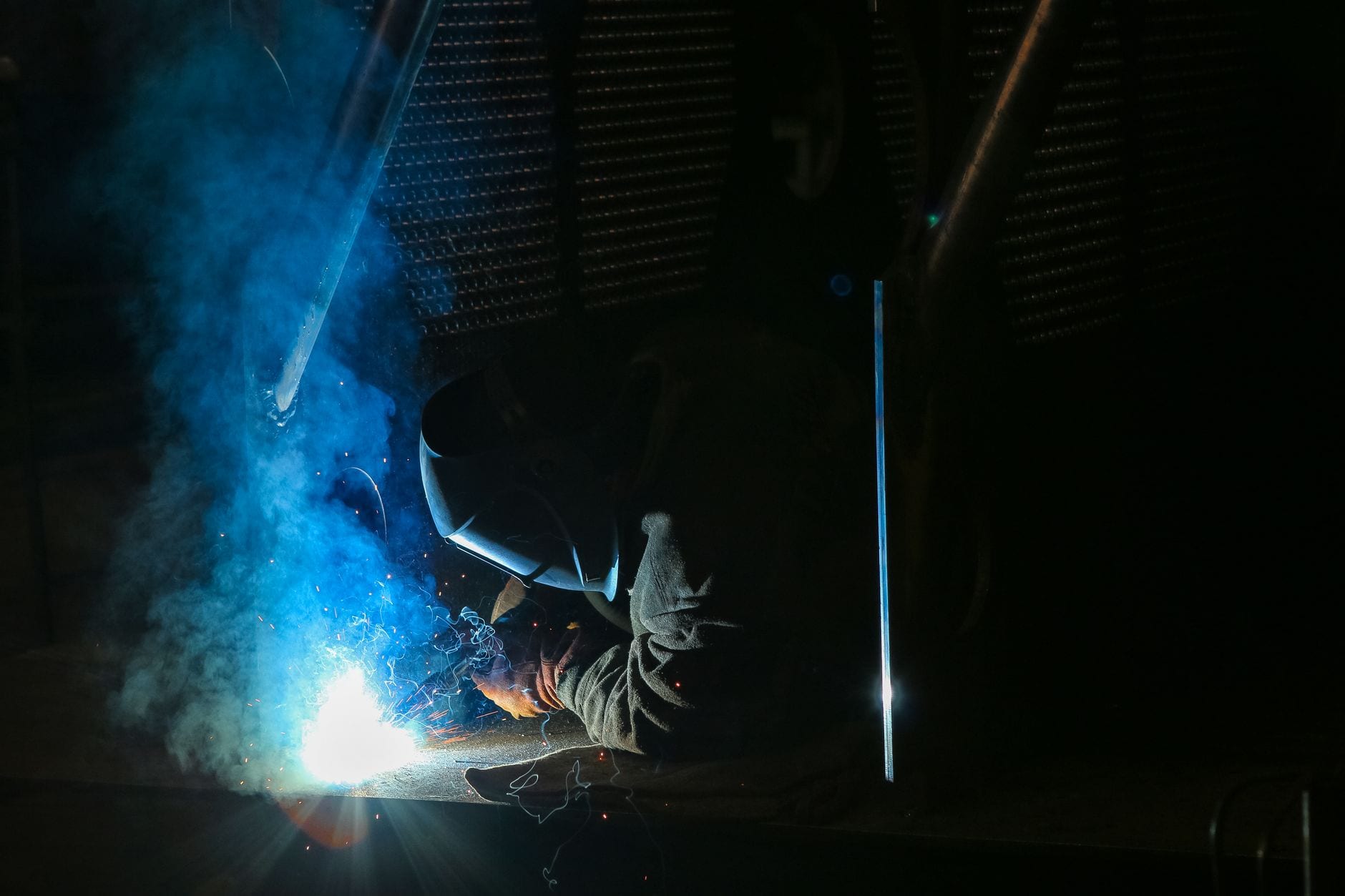
Welding & Fabrication Recruiting
Structural welders, pipe welders, CWI inspectors, and fabrication project managers. Code-qualified talent is the bottleneck, not headcount. We build the pipeline that keeps your shop and your jobsites staffed.
How do you hire welders and metal fabricators in 2026?
Hiring welders and fabricators in 2026 means competing for a shrinking pool of code-qualified talent, not just anyone who can run a bead.
AWS-certified welders (especially those with active pipe certifications or a CWI credential) are the tightest bottleneck, and job boards mostly surface resumes with no way to verify certification status. Commercial fabrication shops and pipeline contractors that win consistently maintain a standing pipeline of pre-vetted, credential-verified welders instead of posting reactively every time a seat opens. My Trade Talent builds and maintains that pipeline on a flat monthly retainer, continuously sourcing structural welders, pipe welders, CWI inspectors, and fabrication PMs across 100+ US markets so open seats fill with qualified people, not guesses.
Certification, not headcount, is the real bottleneck.
Search demand for welder pay and certification pathways dwarfs search demand for staffing help, which tells you where the labor market’s attention actually is. Candidates are chasing credentials and comp; contractors are the ones stuck trying to verify who’s actually qualified.
Pay curiosity is high. Verified-credential supply is not.
“Welder salary” alone draws roughly 18,100 searches a month, with pipe and pipeline welder pay variants adding several thousand more, far outpacing search volume for anything related to hiring or staffing help. That gap is the story: plenty of people want to know what a welder earns, far fewer employers have an efficient way to find one who’s actually AWS-certified for the joint and position they need filled.
American Welding Society (AWS) certification is the baseline credential candidates search for and contractors screen on, and a Certified Welding Inspector (CWI) credential sits a tier above that for quality-control and code-compliance roles. Job boards surface resumes, not verified certifications. That is exactly where a specialist pipeline earns its keep.
Workforce age · BLS 2025
This trade is 2.8 years younger than the American workforce as a whole, not older. The people entering it are not in short supply. The people who supervise it are another 7.1 years further on. That gap is where hiring gets hard: you can find technicians, and you cannot quickly find someone who has been doing it long enough to run a crew.
Promoting from inside takes as long as it takes. If you need someone who can run work now, you are hiring from a pool of people who already have jobs, which is a different job than posting a listing.
Source: U.S. Bureau of Labor Statistics, Current Population Survey, Table 11b (2025 annual averages). See all 20 trades compared →
The 10 most-recruited Welding & Fabrication roles.
These are the positions we maintain active pipelines for in welding and metal fabrication. Each role has its own certification requirements, comp range, and time-to-fill, and we know them all.
Each linked position above opens that role on its own: what it pays, the credentials that move an offer, and the metros paying most for it. All 56 roles we recruit →
What Welding & Fabrication roles pay nationally.
BLS puts the national median for welders, cutters, solderers, and brazers at $53,750 a year, $39,240 at the tenth percentile and $77,530 at the ninetieth, across 416,210 people employed. Structural Welder and Combo Welder sit inside one BLS occupation, so one figure covers all of them - the gap between the tenth and the ninetieth percentile is where that difference shows up. Three roles above - Certified Welding Inspector (CWI), Robotic / Automated Welding Technician and Welding Engineer - fall outside the occupations in this extract and are not listed. Metro-level medians for these occupations are on each market page below.
| Roles | National median | 10th-90th percentile | Employed nationally |
|---|---|---|---|
| Structural Welder · Combo WelderWelders, Cutters, Solderers, and Brazers (51-4121) | $53,750 | $39,240 - $77,530 | 416,210 |
| Pipe / Pipeline WelderPlumbers, Pipefitters, and Steamfitters (47-2152) | $63,800 | $44,150 - $108,420 | 465,840 |
| Fabrication Shop ForemanFirst-Line Supervisors of Construction Trades and Extraction Workers (47-1011) | $79,920 | $53,280 - $128,260 | 812,210 |
| Structural Ironworker / ErectorStructural Iron and Steel Workers (47-2221) | $62,780 | $44,580 - $108,260 | 68,380 |
| Fabrication Project ManagerConstruction Managers (11-9021) | $114,990 | $69,690 - $189,440 | 380,360 |
| EstimatorCost Estimators (13-1051) | $78,740 | $48,530 - $130,820 | 224,220 |
BLS Occupational Employment and Wage Statistics, May 2025, national, cross-industry, all ownerships. Where several of the roles above share one BLS occupation the row names them together, because BLS publishes one figure for the occupation rather than one per job title.
Three resources to hire smarter in Welding & Fabrication.
Each one is built specifically for welding and metal fabrication contractors, not generic recruiting advice. All free. Written by people who do this work every day.
A focused guide on hiring, verifying, and retaining welders and fabricators. Certification-verification tactics, role-specific recruiting playbooks, and a candid look at what works.
Download Definitive Guide to Welding & Fabrication →
Compensation benchmarks for all 10 Welding & Fabrication positions across 9 U.S. Census Divisions. Built from BLS Occupational Employment Statistics data plus our own placement records.
Download 2026 Welding & Fabrication Salary Guide →
A simple, practical framework for interviewing welding and fabrication candidates. Three structured steps to evaluate technical fit, motivational fit, and culture fit, without wasting your time or theirs.
Download 3-Step Interview Guide for Welding & Fabrication →What credentials matter, and what kills offers.
Most searches in this trade fail after the offer rather than before it. These are the credentials that actually gate the work, and the things that most often end a hire between the handshake and the first morning. Every credential below links to the body that issues it. What varies by state is the licensing rule, which is set out on each market page.
The credentials that gate the job
- AWS Certified WelderAmerican Welding Society
The portable one, and the only credential here that belongs to the welder rather than to a job. It is kept alive administratively rather than by an expiry date: the holder must "submit certification maintenance documentation every six months confirming that you continue to perform the welding process for which you were certified". AWS is explicit about the consequence - "failure to maintain continuity may result in the certification becoming inactive, requiring you to requalify through testing". Filed on time, it can stay active indefinitely.
- Welder performance qualification to a code: AWS D1.1, ASME Section IX, API 1104The employer, to the code the work is built to
The distinction that causes the most confusion on a resume. AWS defines qualification as "the demonstration of an individual's ability to produce a weld meeting prescribed standards" and certification as "written verification that a welder has produced welds meeting a prescribed standard". Crucially, "the responsibility for the qualification of welding personnel and procedures lies with the employer", and in practice "many welders must qualify at nearly every job they travel to". Qualification is something you do to a welder, for a procedure, on your paperwork.
- AWS Certified Welding Inspector (CWI)American Welding Society
The quality-control credential, on a nine-year cycle with checkpoints inside it: "the CWI certification is valid for nine years and requires the submissions of a renewal application at years three and six after the initial activation date". Each renewal requires confirming no breaks in practice or employment exceeding two years within the prior three. At nine years, recertification is by the Part B practical exam, 80 professional development hours, achieving the Certified Radiographic Interpreter credential, or adding an endorsement.
What most often kills an offer
- A certification that went inactive because nobody filed a form
This is the quiet one. An AWS Certified Welder credential does not expire on a date, it goes inactive when the six-monthly maintenance documentation stops being submitted, and the route back is requalifying by test rather than catching up on paperwork. A welder who changed employers, or who spent a year on a process other than the one they were certified for, can be inactive without thinking of themselves as uncertified. Check the status, not the certificate.
- Hiring a qualified welder and assuming they are qualified for your work
Qualification attaches to a procedure and to the employer who ran the test, which is why "many welders must qualify at nearly every job they travel to". AWS puts the responsibility plainly with the employer, so a hire arriving from a shop that qualified them to its own procedures gives you a person very likely to pass your test, not a person already qualified to your WPS. Budget the test and the paperwork into the first week rather than the first job.
- The CWI who has been out of the work too long to renew
Renewal at years three and six asks the inspector to confirm no break in practice or employment exceeding two years within the prior three. Someone who left inspection for a spell, or who was out of work, can reach a renewal point unable to make that statement even though the nine years have not run out. Bringing an experienced inspector back into the seat does not by itself put the credential back, so ask where they are in the cycle before the offer depends on it.
Researched from each issuing body and from federal and state agency sources. Licensing and certification rules change; the links above are the authority, not this page.
Hiring questions for Welding & Fabrication
How much do commercial welders make?
The national median for welders is $53,750 a year, according to the latest BLS data (May 2025), but that number moves a lot by state and specialty. The most recent state-level breakdown put medians as low as roughly $47,000 in West Virginia and as high as roughly $77,000 in Hawaii, and pipe-certified or CWI-credentialed welders typically run well above whatever their state’s general median shows. Treat the national figure as a floor, not a target.
What certifications should I require when hiring a welder?
At minimum, an AWS (American Welding Society) certification in the specific process and position you need (6G pipe, structural plate, etc.), since certifications aren’t universal across joint types. For quality-control or code-compliance roles, look for a CWI (Certified Welding Inspector) credential specifically.
Why is it so hard to find qualified welders right now?
Demand for code-qualified welders has outpaced the number of workers completing AWS certification programs, and unlike a resume keyword search, certification status has to be verified directly. Job boards can’t do that for you, and that verification gap is where most open-posting hires fail.
Should I use a staffing agency or hire welders directly?
It depends on how consistently you have open seats. Contingency staffing agencies work in bursts and often resubmit the same unverified candidates across clients. A recruiting partner that maintains a live, credential-verified pipeline specific to welding and fabrication tends to fill faster and with better-fit candidates than a generalist agency.
What should I ask a welder in an interview?
Beyond confirming certifications directly with the issuing body, ask about specific joint types and positions they’ve run in production (not just in testing), what codes they’ve worked to (AWS D1.1, ASME Section IX, API 1104), and how they handle a failed weld on an inspected joint.
Welding & Fabrication hiring intel, by metro.
Each of these market pages covers current wages by role, real hiring conditions, and what it takes to win the hire in that specific metro.
One welding & fabrication seat is open right now.
Not a sample of what we could find - these are seats commercial trades contractors are actively trying to fill, and the applications come to us rather than into a job board.
- Mechanical Welding SuperintendentApply →
Every open role we are running →
Board last synced September 28, 2026. Roles move fast; /jobs/ is always the current list.
We publish how long our own searches actually take. Across every trade the median is 21 days over 88 timed searches in 2026 year to date. We have not closed enough Welding & Fabrication searches yet to break that out - the Hiring Index shows which trades we have. Figures are calendar days from our first contact with the candidate to the hire.
Every hire from zero is a tax on your team.
Every week a seat sits open, the rest of your people are covering for it. Every contingency fee you pay is money that didn't go toward growth. There's a better model. Let's build your pipeline.
Schedule a Discovery Call