
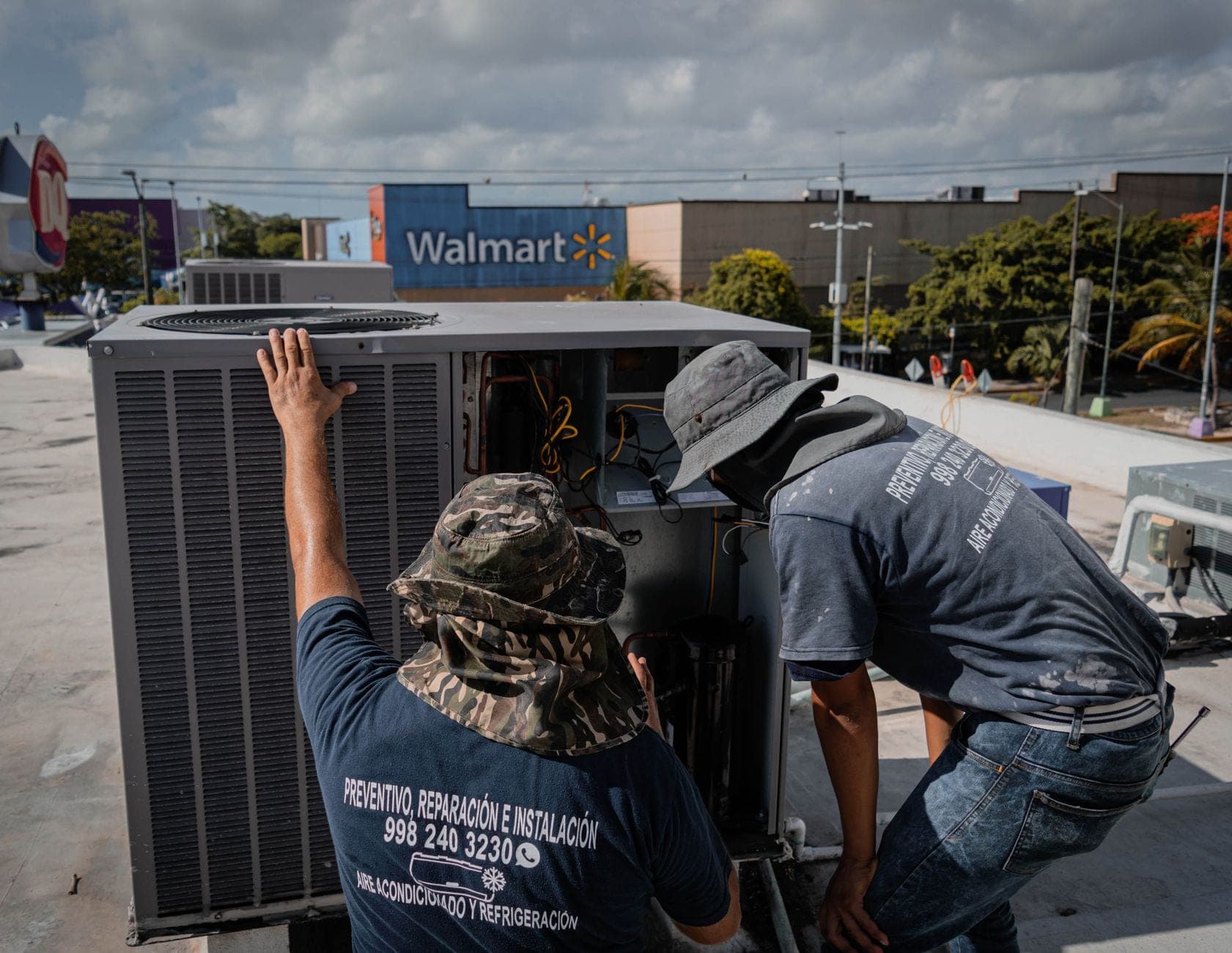
HVAC Service Technician
HVAC & Mechanical-
Walk me through diagnosing a rooftop unit that cools fine in the morning and short-cycles by two in the afternoon.
A strong answer Treats it as load and ambient dependent rather than random, and separates refrigeration causes (high head on a dirty or recirculating condenser, a failing condenser fan, overcharge, non-condensables) from control causes (a thermostat or sensor seeing the wrong thing, a safety cutting out and resetting). Says they would go back when it actually faults, or load it, and take readings while it is faulting rather than diagnosing it cold in the morning.
Follow up with What readings do you take while it is short-cycling, and what would tell you it is a control problem rather than a refrigeration one?
-
What superheat would you expect on a properly charged R-410A system, and what does it tell you when it reads high?
A strong answer Asks about the metering device before giving a number, because the answer differs: a TXV system holds a fairly narrow evaporator superheat, a fixed-orifice system is charged off the manufacturer chart against indoor wet bulb and outdoor dry bulb. Reads high superheat as a starved evaporator and lists undercharge, a restriction, or a TXV underfeeding as the places to look.
Follow up with What do you need to know about the metering device before that number means anything?
-
A tenant says it is too warm and the space is at setpoint. What do you check and in what order?
A strong answer Goes to the space before the equipment. Where the thermostat is compared with where the person sits, whether the sensor is in sun or over a heat source, diffuser throw and whether it is blowing on someone or past them, solar and equipment load in that corner, the VAV box or zone damper, and whether the space was ever balanced for its current use.
Follow up with How do you handle it when the equipment is working correctly and the tenant is still uncomfortable?
-
A rooftop unit trips on high head pressure only on hot afternoons. Where do you start, and what would rule the condenser out?
A strong answer Starts at heat rejection: coil cleanliness including between the slabs, condenser fan running and turning the right way, fan cycling controls, and anything on the roof making the unit breathe its own discharge air. Rules the condenser out by comparing condensing temperature with ambient and judging the split, then moves to overcharge and non-condensables if that split is normal.
Follow up with What split over ambient would you expect, and what does an unusually large one tell you?
-
How do you tell a failed run capacitor from a failing compressor on a call-out, with no parts on the truck?
A strong answer Measures rather than guesses. Capacitance against the rating on the can, visible bulging or leaking, voltage actually arriving at the compressor terminals, contactor contacts, then winding resistance and a check to ground. Knows that a compressor humming and tripping its overload with a good capacitor and good voltage points somewhere different from a capacitor that reads well out of tolerance.
Follow up with What would you measure to tell a grounded winding from a compressor that is mechanically seized?
-
A customer has had three technicians out for the same intermittent fault. What do you do differently on the fourth visit?
A strong answer Reads the previous tickets first and talks to the person who actually experiences the fault about when it happens and what else is happening at the time. Stops swapping parts on suspicion. Either stays until it faults or leaves something behind that records it, and tells the customer what to write down.
Follow up with What would you leave behind on site, and what would you ask them to note?
-
When do you recover and weigh in a charge rather than top it up, and how do you make that call?
A strong answer Weighs in when the charge is unknown, after a significant leak or a component change, or when the refrigerant may be mixed or contaminated. Tops up only on a small leak that has been found and repaired. Either way, finds the leak first, and says so plainly, because topping up a system without finding the leak just books the next visit.
Follow up with What do you tell the customer who wants it topped up when you think it needs a leak search?
-
Walk me through everything you check before you condemn a compressor.
A strong answer Voltage at the terminals under load, capacitor, contactor, overload, windings open or shorted or grounded, oil condition. Then the part that separates a good technician: what killed it. A restriction, a low charge, a dead condenser fan or an overheating problem will kill the replacement too, and they say they would not fit a new compressor without finding the cause.
Follow up with What would you check to make sure whatever killed the first one will not kill the new one?
-
When do you use subcooling rather than superheat to judge a charge?
A strong answer Subcooling on a TXV system, because the valve is already controlling superheat and superheat therefore tells you little about charge. Superheat on a fixed-orifice system against the chart. Gives a working range but says the number that matters is the one on the data plate or in the manufacturer literature for that unit.
Follow up with What is the target on the unit in front of you, and where do you find it?
-
A unit is running but not cooling well and the charge checks out. Where do you go next?
A strong answer Airflow. Filters, both sides of the evaporator coil, a blower wheel loaded with dirt, belt and sheave or fan speed taps, duct static, dampers, and an economizer stuck open pulling hot outside air in. Also checks that every stage or compressor is actually running, and asks whether the load in the space has changed.
Follow up with How would you measure airflow rather than estimate it?
-
Tell me how an economizer is supposed to work, and the three ways you most often find them broken.
A strong answer Free cooling from outside air when conditions allow, with a changeover control deciding when, dampers modulating, and a minimum position held for ventilation. Names real failures: a seized or disconnected actuator, a failed or miswired outdoor air sensor or enthalpy control, broken linkage leaving dampers stuck, and a controller disabled by someone who got tired of complaints.
Follow up with What does a stuck-open economizer look like from inside the building in July, and in January?
-
Hand me a wiring diagram for a unit you have never seen. How do you use it?
A strong answer Finds the legend, separates the line voltage path from the control circuit, traces the sequence of operation, and identifies the safeties wired in series. Uses it to decide where to put a meter rather than reading it end to end, and describes narrowing by finding voltage present at one point and absent at the next.
Follow up with Show me how you would use it to decide the first place you put a meter.
-
Describe your lockout procedure on a rooftop unit with a disconnect you cannot see from where you are working.
A strong answer Their own lock and tag, their own key in their own pocket, then verifying zero energy at the unit with a meter they have tested before and after. Does not rely on someone standing near the disconnect. Raises the possibility of a second supply, because a convenience outlet or a control circuit can be fed from somewhere else entirely.
Follow up with What do you do if you find a second feed you were not expecting?
-
Talk me through recovering refrigerant from a unit you are replacing.
A strong answer Recovery machine and a rated cylinder that has been weighed and will not be filled past its limit, recovering to the level required, keeping refrigerants separate, recording what came out, and never venting. Treats the documentation as part of the job rather than paperwork, and can say why without being prompted.
Follow up with What do you record, and where does the cylinder go afterwards?
-
Explain to me, as if I am the building manager and not a technician, why the unit failed.
A strong answer Plain language with no jargon: what failed, why it failed, what it costs, what happens if it is left, and what would stop it happening again. The test is whether the manager could repeat the explanation accurately to their own boss an hour later.
Follow up with Now tell me the same thing in two sentences.
-
What stops you from going up on a roof?
A strong answer A specific answer rather than a reassuring one. Lightning, ice, wind, a ladder that cannot be secured, a hatch or access that is not safe, no fall protection where it is needed, a roof they cannot satisfy themselves is sound, working alone with nobody knowing they are up there, or being too tired to be safe. Someone who answers nothing has told you something.
Follow up with Tell me about a time you turned around.
Listen for
- Talks in symptoms and causes rather than part numbers - superheat and subcooling readings, not "I replaced the TXV"
- Has worked unaccompanied on rooftop equipment, not just assisted on installs
- Can describe a call they diagnosed wrong and what the second visit found
The mistake
The mistake this seat invites. Hiring on EPA 608 and years of experience without testing diagnostic reasoning. The certification is a floor, not a signal, and residential-heavy experience transfers badly to rooftop and chiller work.
